Bangladesh External Debt and LDC Graduation: What SME Owners Should Do Before 2027
As covered in ZZKR & Co.’s weekly economic roundup of November 1, 2026 (facebook.com/zzkrca), alongside East Asia Forum’s October 13, 2026 analysis by Mustafizur Rahman of CPD.
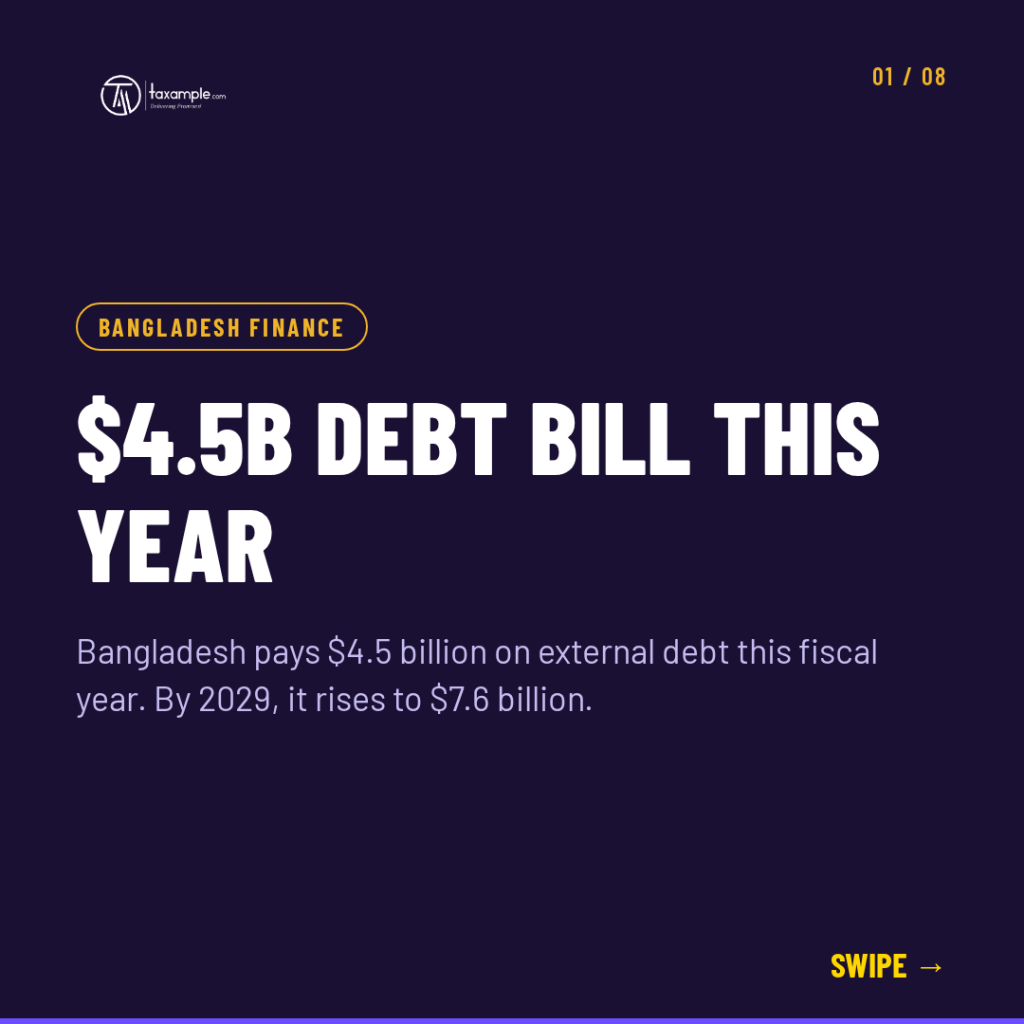
Bangladesh’s external debt service bill is climbing at exactly the wrong moment for any business that borrows. The Economic Relations Division reports the country paid about US$4.5 billion in external debt servicing in the 2025-26 financial year — a significant rise on what it was only a few years ago. The Finance Division projects that figure to reach about US$7.6 billion by 2028-29, as grace periods on several large infrastructure loans end and principal repayments begin.
This lands in the same quarter as two other structural shifts. Bangladesh is slated to graduate from the UN’s least developed country (LDC) category on 24 November 2026, losing trade preferences its apparel exports rely on (Dhaka has asked the UN for an extension; the UN Committee for Development Policy has backed one, shorter than the three years sought, with the General Assembly due to decide before the date). Separately, the country’s earlier lower-middle-income graduation since 2015 has already hardened borrowing terms: the World Bank’s soft-loan window once offered a 0.75 percent service charge with up to 10 years’ grace and 40-year repayment, while some recent loans carry 2-4 percent annual interest with much shorter maturities.
Neither change is about your company directly. But both will be priced into your next loan review, your next audit, and your working-capital line. Here is what SME owners should actually do about it.
1. Your loan terms will harden before the country’s do
Concessional finance is exiting the system. When a country’s blended cost of external borrowing rises from near-zero service charges toward 2-4 percent commercial terms, commercial banks reprice reference rates within quarters, not years. For an SME, that means the facility you signed in 2024 with a concessionary margin needs a fresh look: what is your current effective rate, when does the grace period end, and when does principal repayment start? If the answer lives in an email thread or a PDF nobody re-reads, that is the finding. Lenders will model your debt service coverage ratio; your books must produce the same numbers they will.
2. Banking-sector stress flows downstream to good borrowers
Non-performing loans stand at roughly 32.8 percent of all outstanding bank loans — a level East Asia Forum links directly to governance and transparency failures in the financial sector. Banks in that position do three things: raise spreads on new lending, collateralize harder, and audit existing borrowers more frequently. SMEs with clean, reconciled, audit-ready books face the mildest version of this. SMEs whose numbers take two weeks to assemble face the harshest — because the bank’s own uncertainty becomes your pricing.
3. Revenue reform means compliance diligence will rise
With a revenue-to-GDP ratio around 8 percent — among the lowest in the developing world — the government’s 2026-27 program leans on tax administration reform: separating policy from implementation, digitalizing collection through e-submission, incentivizing cashless QR-based transactions, and ensuring interoperability of systems. Every one of those measures increases the digital paper trail your transactions leave. The practical reading: an SME’s books that reconcile to bank statements automatically are cheaper to defend than books that reconstruct by hand. Digitalization does not just mean the NBR can see more — it means anyone who reviews you can verify faster.
4. 2026 comparatives must survive an auditor’s lens
LDC graduation will push exporters to diversify markets and financing. Any new lender, partner, or buyer diligence will start with FY2025-26 comparatives — the year of graduation, the year of the FX stress. Clean comparatives are built now, in the ledger, with automated bank reconciliation and no unposted suspense items. IFRS 18 (effective for periods from 1 January 2027) raises the bar on presentation and comparatives in parallel; restatement-ready books are the cheapest way to meet both pressures at once.
5. Cost discipline is shifting from the country to the firm
East Asia Forum’s conclusion is that Bangladesh must raise the efficiency of all government operations to contain debt pressure and escape the middle-income trap. The private-sector translation is uncomfortable: when the state’s fiscal space tightens, the firms that thrive are the ones whose unit economics are visible this month, not after an annual audit. That is a systems question. One ledgers-to-reports pipeline — sales in, inventory moved, bank reconciled, VAT computed, reports issued — is what makes cost decisions before quarter-end possible.
What to do this week
- Build a single register of every loan facility: lender, rate, grace end, repayment end, FX terms.
- Reconcile every bank account in the ledger — automatically, not by year-end spreadsheet.
- Ask your accountant whether your FY2025-26 comparatives could survive diligence tomorrow.
We help Bangladeshi SMEs set up audit-ready, reconciled Odoo books — the same discipline the debt-era demands of the country, applied to your company ledger. Our bookkeeping service runs reconciliations continuously; talk to us for a 15-minute walkthrough.
Sources
- Mustafizur Rahman, “Bangladesh’s LDC graduation comes with a bill,” East Asia Forum, 13 October 2026. (Debt servicing US$4.5bn FY2025-26 per ERD; ~US$7.6bn by 2028-29 per Finance Division; ~8% revenue/GDP; NPLs ~32.8%.)
- ZZKR & Co., Chartered Accountants — weekly economic roundup, November 1, 2026 (external debt obligations, revenue mobilisation, banking-sector losses, export financing, LDC graduation). Topic source only; all analysis ours.
Frequently asked questions
When is Bangladesh’s LDC graduation, and can it be delayed?
Bangladesh is scheduled to graduate from LDC status on 24 November 2026. Dhaka has requested an extension; the UN’s Committee for Development Policy supports a shorter extension than the three years sought, and the General Assembly is due to decide before the date. Regardless of outcome, reform and debt-management pressure stays.
How much is Bangladesh paying on external debt?
About US$4.5 billion of external debt servicing in FY2025-26, per the Economic Relations Division, projected to reach roughly US$7.6 billion by 2028-29 as grace periods end on large infrastructure loans.
What does this mean for SME loan costs?
Concessional windows (once 0.75 percent service charge, 10-year grace) are giving way to 2-4 percent commercial terms with shorter maturities. Banks, facing roughly 32.8 percent NPLs, reprice spreads and audit borrowers more often. SMEs should map every facility’s rate, grace end, and repayment schedule now.
How should an SME prepare its books for this environment?
Keep a complete loan register, reconcile bank accounts automatically through the year, keep FY2025-26 comparatives audit-clean, and run one integrated system so VAT, payables, and reports are always current. Audit-ready books price better with lenders and diligence teams.
Last updated: November 1, 2026
About the Author
This article was reviewed and published by the Taxample Editorial Team at Taxample.com, a licensed Odoo Partner and management consulting firm in Dhaka, Bangladesh. Our content is reviewed by Md. Mahdi Mobashir, Founder Partner & CEO — Part-Qualified Chartered Accountant, Odoo Certified Professional, MBA (IBA), ITP. Learn more about Taxample.
