

As covered in ZZKR & Co.’s weekly economic roundup for the week of 19–25 October 2026, Bangladesh’s headline pressures have not eased: foreign-exchange pressure, household cost-of-living challenges, steel-scrap import risks, power-sector financing and export-oriented investment all made their weekly list. Scroll any Bangladeshi import business owner’s phone this month and the same three numbers keep appearing. The dollar sits near 124 taka. Inflation printed 8.34 percent in September. Wages have trailed prices for 43 straight months.
For SMEs that import goods or inputs, these are not abstract macro indicators. They are a double squeeze on margin — and most accounting systems in Bangladesh cannot see it happening until year-end. This post breaks down what the FX and cost-of-living data actually means for SME finance teams, and what to fix in your books this month.
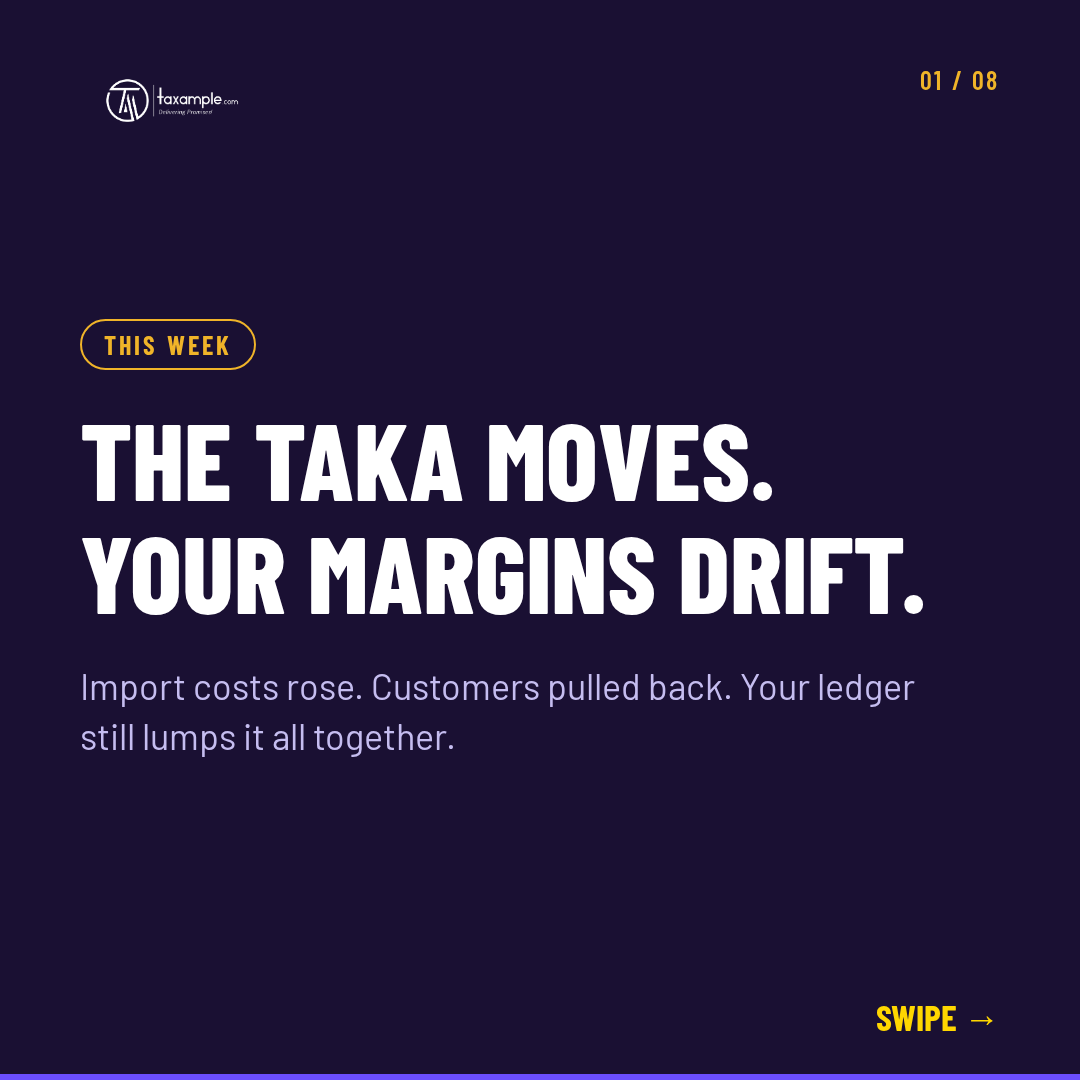
The October numbers behind the squeeze
Three data points frame the problem for any Bangladeshi SME finance team this month:
- Exchange rate: Bangladesh Bank’s FX reference rate has held around 123.7 taka per US dollar through the third week of October 2026 — up steadily from about 123.0 at the start of the month.
- Reserves: gross forex reserves crossed USD 36 billion in October, a healthier buffer than a year ago, but importers still face documentation rules and timing gaps on letters of credit.
- Inflation: general inflation rose to 8.34 percent in September 2026, from 8.26 percent in August, with food inflation near 8.24 percent. Real wages have lagged prices for 43 consecutive months.
Put together: your inputs cost more in taka, your customers have less taka to spend, and the gap between the two is your margin. ZZKR & Co.’s roundup framing is accurate — the pressure is real. What their summary does not cover is what it does to your ledger.
Five implications for SME finance teams
- Landed cost is not purchase price. When the dollar moves from 123.0 to 123.7 in three weeks, the sticker price on your purchase order is already wrong. Freight, customs duty, port charges and bank fees all reprice with it. If your system records only the invoice amount, every margin report you run understates true cost.
- Annual price lists are dead at 8 percent inflation. Businesses that reset prices once a year are absorbing two quarters of unseen cost increases. At current inflation and taka movement, a quarterly — or monthly — pricing review is the minimum viable cadence for importers.
- Bank reconciliation drifts first. Multi-currency transactions, LC charges and remittance fees pile up as small unexplained differences. By the time someone reconciles manually, the cash position you are managing from is days or weeks stale.
- Margin hides at product level. The overall P&L can look fine while specific imported SKUs quietly bleed. Per-product landed cost and margin reporting is what exposes which products still earn their shelf space at 124 taka per dollar.
- Cash planning needs a forex line. LC margins, duty prepayments and advance payments all pull taka forward, while receivables lag. Without a forward-looking cash view built on real payment dates, an import SME can be profitable on paper and broke on payroll week.
What to build in your system this month
None of these five problems requires a CFO. They require a ledger that captures cost at transaction time. In practice, on Odoo:
- Landed costs on every purchase order. Odoo lets you attach freight, customs and duty lines directly to a receipt, so each product carries its true cost per unit — automatically recalculated when rates move. This is the single highest-value configuration for importers, and it is standard on Odoo Community in Bangladesh.
- Automatic bank reconciliation. Bank statements import daily; Odoo matches payments to invoices and flags the residue. Your cash view stays current without a manual entry. Teams running remote bookkeeping with a reconciliation habit close the loop weekly instead of quarterly.
- Multi-currency with revaluation. Record payables in USD, let Odoo revalue at current rates, and see the FX gain or loss per period instead of discovering it at audit.
- Margin by product report. One saved report, reviewed monthly, keeps the bleeding SKUs visible while you can still reprice them.
The theme across all four: visibility. You cannot reprice what you cannot see. The SMEs that weather FX pressure are not the ones with the smartest forecasts — they are the ones whose books show the hit in real time.
Frequently asked questions
What is the current USD to BDT exchange rate?
As of the third week of October 2026, Bangladesh Bank’s FX reference rate is approximately 123.7 taka per US dollar, up from about 123.0 at the start of the month. The rate has moved steadily upward through October, which directly reprices every import order a Bangladeshi SME places in US dollars.
How does taka depreciation affect import businesses in Bangladesh?
Depreciation raises the taka cost of every dollar-denominated input: goods, freight, customs valuation and bank charges. Margins compress unless prices are adjusted, but with inflation at 8.34 percent and consumer spending squeezed, price increases are harder to pass on. Importers respond by tracking true landed cost per product and repricing continuously rather than annually.
What is landed cost and why does it matter for SMEs?
Landed cost is the total cost of a product once it reaches your warehouse: purchase price plus freight, insurance, customs duty, port charges and bank fees. Recording only the invoice amount understates true cost and distorts margin reports. ERP systems like Odoo attach these cost lines to each receipt so the real per-unit cost carries through accounting automatically.
How can SMEs automate bank reconciliation in Bangladesh?
Most accounting systems, including Odoo, can import bank statements daily and auto-match payments to invoices using amount, reference and partner matching. Fees and FX differences are flagged as residual lines for review. SMEs that reconcile weekly catch errors, duplicate charges and missing LC fees in days instead of at audit time — and always know their real cash position.
Sources: ZZKR & Co., Chartered Accountants — weekly economic roundup, week of 19–25 October 2026 (facebook.com/zzkrca); Bangladesh Bank FX reference rate and international reserves data (bb.org.bd), October 2026; The Daily Star, “An economic buffer: Bangladesh’s gross forex reserves reach $36 billion”, 11 October 2026; TBS News / Bangladesh Bureau of Statistics, September 2026 CPI release.
Topic selected from ZZKR & Co.’s public weekly roundup of 19–25 October 2026 and re-analyzed with original Taxample commentary for SME owners and finance teams. Taxample is not affiliated with ZZKR & Co.
Last updated: October 27, 2026
About the Author
This article was reviewed and published by the Taxample Editorial Team at Taxample.com, a licensed Odoo Partner and management consulting firm in Dhaka, Bangladesh. Our content is reviewed by Md. Mahdi Mobashir, Founder Partner & CEO — Part-Qualified Chartered Accountant, Odoo Certified Professional, MBA (IBA), ITP. Learn more about Taxample.
